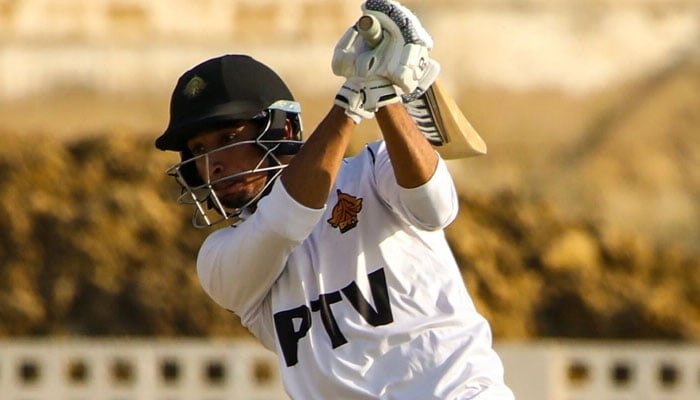
Every few years, a domestic scorecard stops the whole of Pakistan cricket in its tracks. On 24 September 2026, at Islamabad’s Diamond Cricket Ground, Pakistan Television were wobbling at 34 for three against Hyderabad Kingsmen Academy in the President’s Trophy. By the time their number five was dismissed, the record books had been rewritten. Muhammad Shahzad, a 22-year-old all-rounder from Dera Ghazi Khan, had reached his hundred from just 49 balls — the fastest first-class century ever scored by a Pakistani, seven balls quicker than the mark Misbah-ul-Haq set in a Test match twelve years earlier.
Shahzad finished with 114 off 62 balls, with twelve fours and eight sixes. But what makes his story worth reading is not only the speed of that innings. It is where he started: a city in southern Punjab with barely any cricket infrastructure, a family that lost its father early, and a boy who left home at fourteen with a kit bag and a plan.
| Full name | Muhammad Shahzad |
| Born | 5 February 2004, Dera Ghazi Khan, Pakistan |
| Age | 22 |
| Role | Batting all-rounder |
| Batting style | Right-handed |
| Bowling style | Right-arm medium-fast |
| Height | 6 ft |
| Teams | Pakistan Television (PTV), Islamabad United, Multan Region, Pakistan Under-19s |
| Record | Fastest first-class century by a Pakistani — 49 balls (24 September 2026) |
| Senior Pakistan caps | None yet — uncapped |
Table of Contents
- Forty-Nine Balls: Anatomy of a Record
- The Company He Now Keeps
- Dera Ghazi Khan: A Childhood Shaped by Loss
- Built by the Pathway: Under-16 to a World Cup
- The Grind: Multan, PTV and Heavy First-Class Numbers
- A Small Taste of the Big League
- Hong Kong Calling
- What Kind of Player Is He?
- Personal Life
- Frequently Asked Questions
Forty-Nine Balls: Anatomy of a Record
The innings deserves to be told properly. It was the opening day of a third-round President’s Trophy Grade-I fixture, and PTV’s top order had collapsed around him — 34 for three when Shahzad walked in at number five, a situation that usually demands careful survival. Instead, he counterattacked. Boundaries came in clusters: the drives through the off side, the pick-up shots over midwicket, eight sixes in all. A 143-run fourth-wicket partnership dragged PTV out of trouble and towards 285 for seven by the close, but the partnership was, in truth, a supporting act.
Shahzad brought up his hundred in 49 balls — the eighth-fastest century in the entire history of first-class cricket — and eventually fell to Zia-ul-Haq for 114 from 62 deliveries. It was the sixth first-class hundred of his career, and easily the most consequential. Within two weeks, the PCB had named him in Pakistan’s squad for the Hong Kong Sixes, and Wisden was writing about an uncapped 22-year-old who had just outpaced a legend.
The Company He Now Keeps
To understand what 49 balls means, look at the list Shahzad now tops. The previous fastest first-class hundred by a Pakistani belonged to Misbah-ul-Haq, whose 56-ball century against Australia in the 2014 Abu Dhabi Test equalled Viv Richards’ then world record for the fastest Test hundred. Brendon McCullum later took that Test record with a 54-ball hundred in 2016, but Misbah’s mark stood as the Pakistani benchmark for nearly twelve years. Behind him come Hasan Ali’s 58-ball hundred in the 2021 Quaid-e-Azam Trophy final, then Saud Shakeel (70) and Javed Miandad (71).
One honest caveat: Misbah’s hundred came in a Test, Shahzad’s in domestic cricket — and the all-time first-class record is a scarcely believable 27 balls, shared by Glen Chapple (1993) and Mark Pettini (2006). Shahzad’s 49 sits eighth on that list, achieved before he had won a single senior cap.
Dera Ghazi Khan: A Childhood Shaped by Loss
Muhammad Shahzad was born on 5 February 2004 in Dera Ghazi Khan, in the south of Punjab, and started playing cricket at nine, mostly in the streets against older boys — an education he credits for toughening his game. His family was not well off; his father died when he was young, and from his early teens he carried real responsibility at home, where his mother raised him alongside five younger brothers.
Dera Ghazi Khan had passion for cricket but almost none of the facilities. On the advice of those who had seen him play, he made the hardest decision of his life at fourteen: leaving home for Lahore to train at an academy. He has spoken openly about the cost — his schooling effectively stopped after grade nine, with cricket taking everything — and about his hope of returning to his studies one day. His heroes explain the player he became: Imran Khan is his all-time favourite cricketer, and from the current generation he has said he admires Babar Azam most. In 2015 he had taken his first step into organised hard-ball cricket with the Zakariya Cricket Club back home; Lahore turned that raw material into a professional.
Built by the Pathway: Under-16 to a World Cup
The PCB’s age-group system spotted him quickly. Playing for Multan Under-16s, Shahzad announced himself as the best batter at the PCB Under-16 Pentangular tournament in 2018-19, scoring 309 runs in five matches, and was picked for Pakistan Under-16 series against Bangladesh, as well as a series against Australia Under-16s in the UAE.
He was named in Pakistan’s squad for the ICC Under-19 World Cup in South Africa in 2020, in a group captained by Rohail Nazir that also included fast bowler Abbas Afridi — the man under whose captaincy Shahzad will now play at the Hong Kong Sixes. Head coach Ijaz Ahmed singled him out before that World Cup for how quickly he absorbed instructions, telling reporters to remember his name. Six years on, that prediction looks rather good.
The Grind: Multan, PTV and Heavy First-Class Numbers
Plenty of age-group stars stall when they reach senior cricket. Shahzad did the opposite: he became a volume scorer in the longest format. For Multan Region in the Quaid-e-Azam Trophy he made 335 runs in five innings, including a century, and his move to Pakistan Television for the President’s Trophy brought a genuine breakout. In the 2024-25 edition he piled up 706 runs in nine matches — three centuries and four fifties — while also taking 20 wickets with his medium pace, including a five-wicket haul.
By the time of the record innings, his career figures already marked him out as a serious first-class cricketer: 1,393 runs at 44.93 in his first twenty matches, with five hundreds and 27 wickets. The 49-ball hundred was his sixth century. His List A and T20 numbers are more modest, which is part of what makes the record so striking — this is not a T20 slogger on a hot streak, but a red-ball batsman whose game happens to include white-ball violence.
A Small Taste of the Big League
The PSL has so far given him only sips, not gulps. He was part of Multan Sultans’ squad for PSL 9 in 2024 without getting a game — the classic young player’s season of carrying drinks. Islamabad United drafted him for PSL 10 in 2025, and there he finally got his chance, making his debut in the season opener against Lahore Qalandars. Four appearances brought 24 runs in four innings at a strike rate above 133, plus a wicket: small numbers, but a first foothold. He has talked about how much he took from sharing a dressing room with senior internationals such as Jason Holder. For a player whose first-class record now demands attention, the next PSL season feels like the moment the foothold becomes a platform.
Hong Kong Calling
The reward for the 49-ball hundred arrived quickly. On 9 October 2026, the PCB named Shahzad in a seven-man Pakistan squad for the Hong Kong Sixes, the six-a-side tournament in which Pakistan are the defending champions. A-Sports, reporting the squad, drew the line directly: the selection followed his record-breaking century for PTV. Reports also note he was in the announced Sixes squad the previous year too.
The selectors’ logic is easy to see: in a six-overs-a-side game, a number five who scores at two runs a ball and can also bowl is exactly the profile teams hunt for. He will play under Abbas Afridi’s captaincy, with a group match against India on the opening day, 30 October. A senior Pakistan cap in the conventional formats remains the bigger prize — and no longer looks a distant one.
What Kind of Player Is He?
At six feet tall, Shahzad has the frame of the modern power player, but his game is more organised than the record headline suggests. An opener in age-group cricket, he has since added middle-order hitting. The record innings came from number five, and it was a counterattack rather than a slog — proper shots, hit hard, against a new-ish ball with his team in trouble. His medium pace is a genuine second skill rather than a token: 27 first-class wickets and a five-wicket haul in a single President’s Trophy season is real all-round output. The profile — top-order technique, middle-order hitting, useful seam — is precisely the one Pakistan’s selectors spend years searching for.
Personal Life
What is publicly known about Shahzad’s life away from cricket comes mostly from his own interviews, and it is a story of responsibility rather than glamour. His father died when he was young, and Shahzad has described committing himself to cricket while helping shoulder his family’s future — his mother and five younger brothers back in Dera Ghazi Khan. He is candid that education took a back seat, ending after grade nine, and that he hopes to resume it. There is no publicly verified information about his marital status, and no credible reporting of his net worth; both are left blank here rather than filled with invention. For now, the biography that matters is the one being written on first-class scorecards.
Frequently Asked Questions
On 24 September 2026, playing for Pakistan Television against Hyderabad Kingsmen Academy in the President’s Trophy, Shahzad hit a hundred off 49 balls — the fastest first-class century by a Pakistani. It broke Misbah-ul-Haq’s 56-ball record from the 2014 Abu Dhabi Test against Australia.
Not yet at senior level — he is still uncapped. He represented Pakistan at Under-16 and Under-19 level, was part of the 2020 Under-19 World Cup squad, and in October 2026 was named in Pakistan’s squad for the Hong Kong Sixes.
He plays first-class cricket for Pakistan Television (PTV) in the President’s Trophy and has represented Multan Region in the Quaid-e-Azam Trophy. In the PSL he plays for Islamabad United, having earlier been in Multan Sultans’ squad without making an appearance.