Talha Anjum: Age, Career, and Rise to Fame
Talha Anjum was born on October 3, 1995, in Karachi, Pakistan, and has grown into one of the country’s most recognizable rap voices. He co-founded the hip-hop duo Young Stunners with Talhah Yunus, and though he originally trained in architecture, music eventually won out, and he’s been recording since 2013. As a solo artist, he has released two studio albums, Open Letter (2023) and My Terrible Mind (2024), and took his first screen role in the 2024 film Kattar Karachi. Songs like “Afsanay,” “Departure Lane,” “Rozi,” and “Rasta” have become staples of his catalog, and together they’ve helped shape what Urdu rap sounds like in Pakistan’s fast-growing hip-hop scene.
Who Is Talha Anjum and Why Does He Matter?
Talha Anjum is a Pakistani rapper and songwriter best known as one half of the hip-hop duo Young Stunners, which he co-founded with Talhah Yunus. Born on 3 October 1995 in Karachi, Sindh, Pakistan, he’s widely seen as one of the leading voices in Urdu-language hip-hop, and his work played a real part in moving Urdu rap out of underground circles and into Pakistan’s mainstream music industry.
His music leans into Karachi’s dense, unfiltered urban reality, giving voice to experiences that rarely show up in Pakistani pop music. That’s a big reason his catalog carries weight well beyond raw streaming numbers.
What makes Talha Anjum’s career trajectory unique?
Talha Anjum first reached national attention as one half of Young Stunners, the duo he co-founded with his longtime friend Talhah Yunus. The pair are frequently credited with helping push Urdu rap from the underground into the Pakistani mainstream. As a solo artist, Talha Anjum has released two studio albums and starred in the 2024 film Kattar Karachi.
How does his background shape his music?
Growing up amid Karachi’s crowded, restless urban culture gave Talha Anjum the raw material for his music. His lyrics carry the city’s contradictions — struggle and ambition, heartbreak and resilience — and that’s likely why so many listeners hear their own lives echoed back in his verses.
Talha Anjum’s key identifiers at a glance:
| Attribute | Detail |
|---|---|
| Talha Anjum age | Born 3 October 1995 (age 30) |
| Genre | Hip-hop |
| Occupation | Rapper, songwriter, lyricist |
| Years active | 2013–present |
| Group | Young Stunners (co-founder) |
| Solo albums | Two studio albums |
| Film debut | Kattar Karachi (2024) |
His influence reaches beyond the music itself. Talha Anjum represents a generation of Pakistani artists who chose not to imitate Western hip-hop, and built an Urdu-language sound instead that speaks directly to local experience.
What Is Talha Anjum’s Age and Early Life?
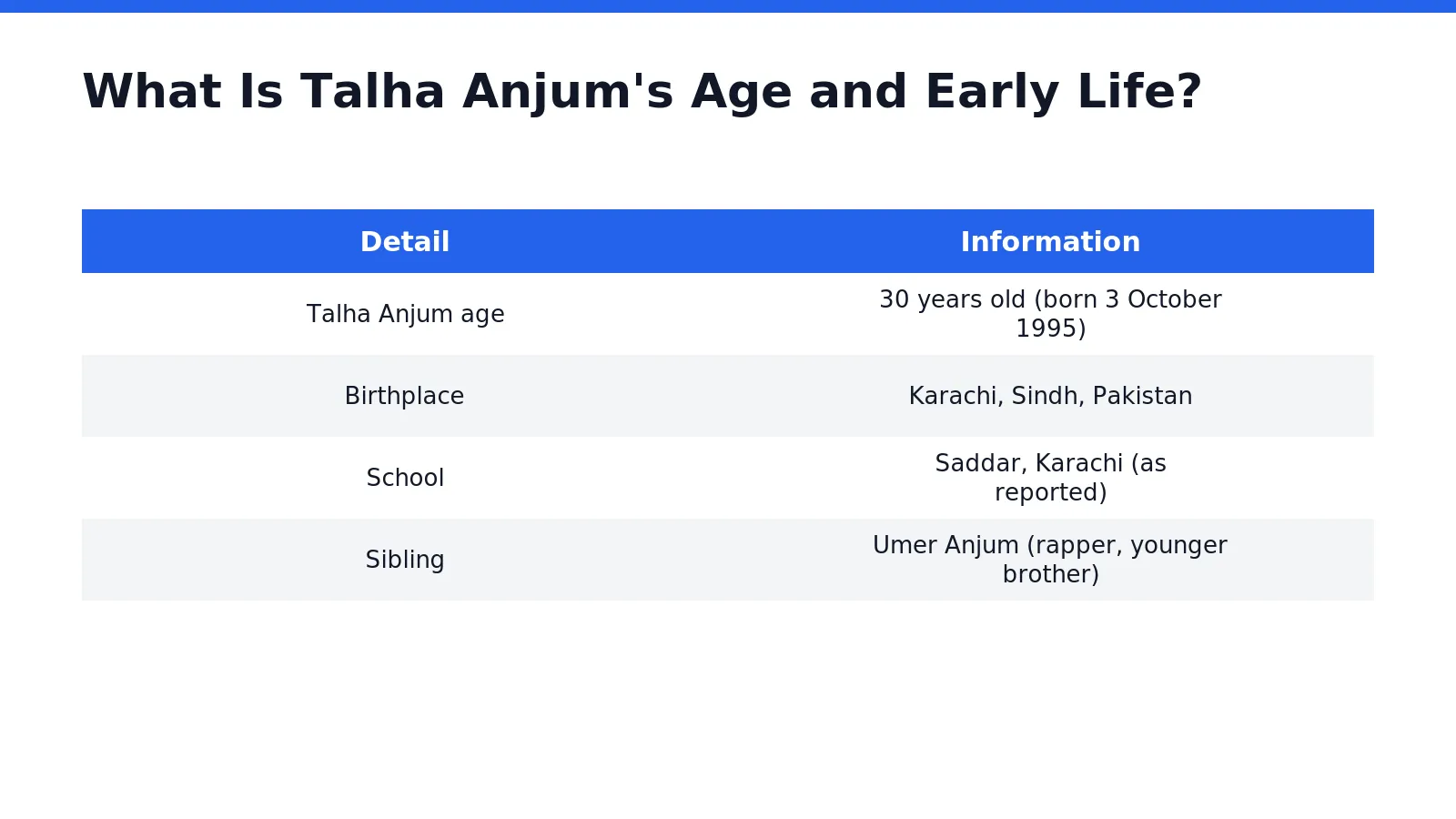
Talha Anjum was born on 3 October 1995 in Karachi, Sindh, Pakistan, which makes him around 30 years old. He grew up in the city’s dense urban environment, a setting that would later become a defining subject in his music.
Where Did Talha Anjum Grow Up?
Talha Anjum spent his childhood in Karachi, attending school in the city’s Saddar area, as reported. The neighborhood’s fast-paced, gritty street culture left a clear mark on his perspective and his lyrics, and the city’s struggles and energy still surface throughout his discography.
Does Talha Anjum Have Siblings?
Yes — Talha Anjum has a younger brother, Umer Anjum, who is also a rapper. The two share a musical background, though Talha Anjum remains the more prominent figure in Pakistan’s hip-hop scene.
| Detail | Information |
|---|---|
| Talha Anjum age | 30 years old (born 3 October 1995) |
| Birthplace | Karachi, Sindh, Pakistan |
| School | Saddar, Karachi (as reported) |
| Sibling | Umer Anjum (rapper, younger brother) |
What Shaped His Early Musical Style?
Karachi’s urban culture supplied the raw material for Talha Anjum’s earliest work. The city’s mix of languages, economic disparity, and youth culture gave him a voice of his own, shaped by local street poetry as much as by international hip-hop, and he blended the two into something distinctly Urdu. That foundation is what led him to co-found Young Stunners with Talhah Yunus, carrying Urdu rap out of underground scenes and into the mainstream.
How Did Talha Anjum’s Career Take Off?
Talha Anjum’s career took off when his childhood friend Talhah Yunus recognized what the two of them could build together back in school, and Young Stunners was born. The partnership reshaped Karachi’s underground rap scene. Between 2013 and the mid-2010s, the duo built a loyal local following on raw, unpolished tracks that captured everyday urban Pakistani life.
Working out of Karachi, Young Stunners brought Urdu rap into a Pakistani music industry that had long been dominated by English-language hip-hop, and that language shift turned out to be decisive. Listeners who’d never connected with rap in English suddenly heard their own slang, their own struggles, their own streets reflected back at them. The duo is frequently credited with helping push Urdu rap from the underground into the Pakistani mainstream, a shift that took roughly five years of steady releases to land.
He was just 17 when he started out in 2013, so in a real sense he grew up alongside his audience. He’s been active in the industry ever since, releasing his first tracks while he was still figuring out young adulthood in Karachi himself. That early start gave Young Stunners a credibility that more radio-friendly acts couldn’t easily match.
What Role Did Young Stunners Play in the Breakthrough?
Young Stunners’ rise turned Talha Anjum into one of the most talked-about names in Pakistani hip-hop and drew national media coverage. The duo’s early singles spread phone-to-phone and through YouTube uploads, skipping traditional radio gatekeepers altogether. By the time mainstream outlets caught on, Young Stunners had already built a fanbase big enough to fill live venues across Karachi.
When Did Solo Work Begin Alongside the Duo?
Even as Young Stunners gained traction, Talha Anjum kept releasing solo tracks alongside the duo’s output. That dual approach — group projects plus individual songs like “Afsanay” — kept his name circulating across multiple playlists and widened his reach without pulling focus from the duo’s brand.
What Are Talha Anjum’s Most Popular Songs?
Four of Talha Anjum’s tracks on Spotify have each crossed 49 million plays. “Downers at Dusk” leads the pack with over 117 million streams, followed by “Afsanay” at over 80 million, “Departure Lane” at over 77 million, and “REGRETS” at over 49 million. These four songs form the core of his mainstream recognition and capture his signature mix of Urdu-language hip-hop and introspective lyricism.
Which Albums Define His Discography?
As a solo artist, Talha Anjum has released two studio albums that trace how his artistry has grown. “Open Letter” arrived in 2023, followed by his most recent record, “My Terrible Mind,” in 2024. Each album marks a step up in production and thematic depth, moving from raw street narratives toward more polished, emotionally layered storytelling.
What Recent Singles Has He Released?
| Single Title | Release Year |
|---|---|
| JHOOT | 2026 |
| Kingsmen | 2026 |
| Let’s Go | 2026 |
| Shikaar | 2026 |
| 2AM IN LONDON | 2026 |
| Baap Log | 2026 |
| Rock Bottom | 2025 |
| HAWA ANEY DE | 2025 |
His 2025 output included “Rock Bottom” and “HAWA ANEY DE,”. 2026 has already brought six new singles: “JHOOT,” “Kingsmen,” “Let’s Go,” “Shikaar,” “2AM IN LONDON,” and “Baap Log.” That steady pace of releases keeps him visible on the streaming charts and keeps him connected with an ever-widening audience.
Talha Anjum’s Religion, Acting, and Personal Life
Talha Anjum was born on 3 October 1995 in Karachi, Sindh, Pakistan, and raised in a Muslim household. That upbringing forms part of the cultural backdrop behind his identity, and it often comes through in the texture of his Urdu hip-hop, which draws heavily on everyday life in Karachi.
His work has also carried him into film. He starred in the 2024 movie Kattar Karachi, his acting debut, a role that introduced his on-screen presence to a wider audience and stretched his creative range beyond the recording studio.
Talha Anjum hasn’t publicly confirmed his marital status, and no verified source names a spouse. Like many public figures, he keeps his personal relationships largely out of the spotlight.
His family life follows a similar pattern of privacy. His younger brother, Umer, is also a rapper, but few other details about their relationship have been shared publicly. What’s known about Talha Anjum publicly centers mainly on his birth date, birthplace, and schooling in Saddar, Karachi — beyond that, listeners connect with him mostly through the lived experience woven into his music.
Conclusion
In closing, Talha Anjum’s journey reflects a rare blend of artistry and discipline, shaped by his early education, family influence, and relentless passion for music. From his formative years to his rise as a respected name in Pakistan’s hip-hop scene, his career stands as a testament to consistency and creative evolution. His discography continues to resonate with listeners, proving that authenticity and hard work remain timeless. Talha Anjum’s story ultimately inspires aspiring artists to pursue their craft with sincerity and purpose.